Monitoring displacements of the earth's surface and objects
Modern methods of multi-pass differential interferometry provide for joint analysis of large time series of remote sensing radar data (space photography) using specialized processing algorithms. The result of this processing is a model of vertical displacements of the earth's surface and objects on it, obtained for the entire observation period.
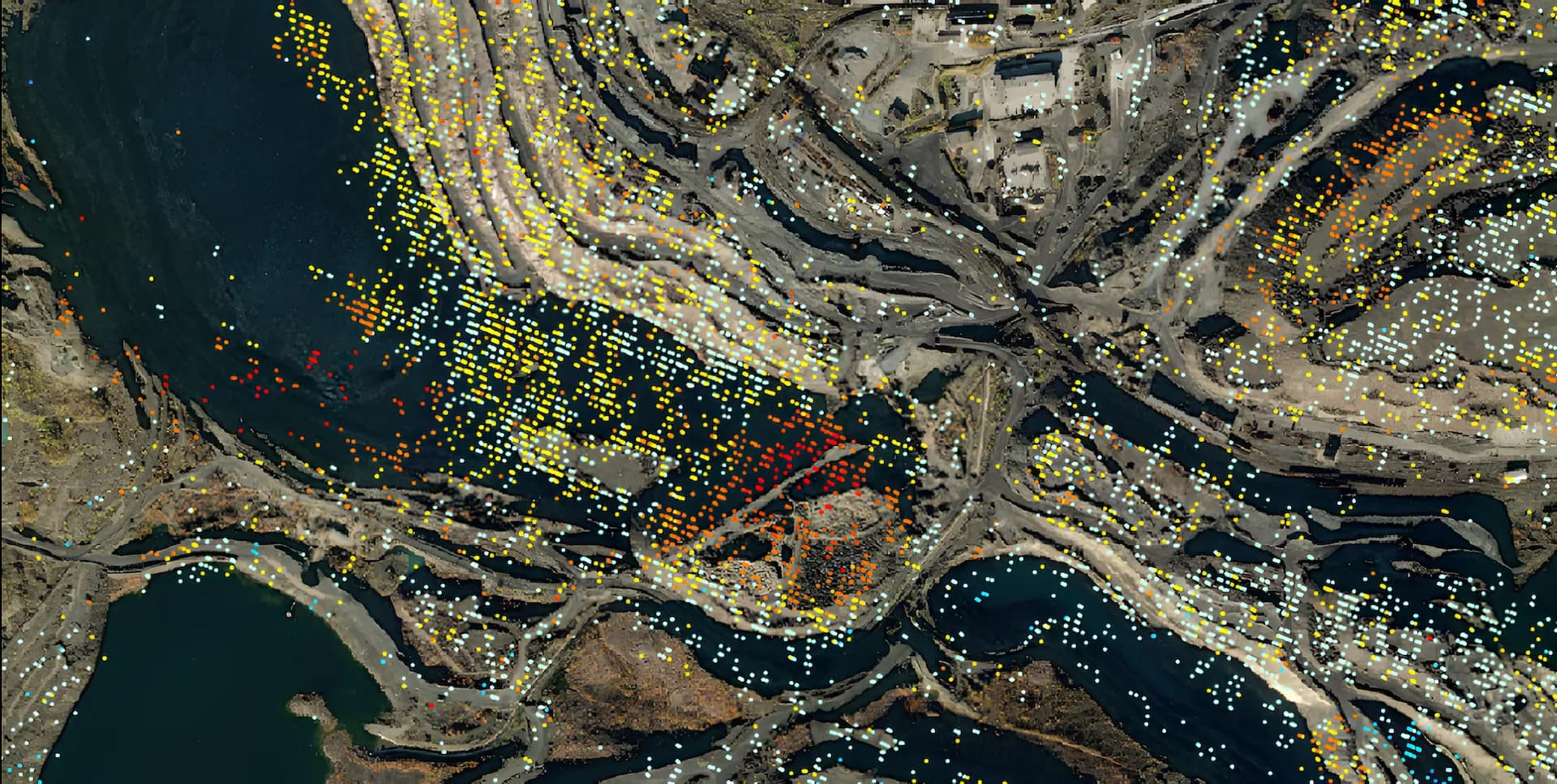
Depending on the chosen processing and analysis method, the displacement model is:
- 1
An irregular cloud of measurement points obtained mainly from artificial objects on the ground: embankments, dams, buildings, objects of the railway and road infrastructure, for which the average annual speeds of displacements are defined and a consistent dynamics of displacements for the entire observation period is restored. The accuracy of measuring displacements reaches the level of several mm.
- 2
A raster model of displacements defined for areal reflectors (surface areas) corresponding to the spatial resolution of the data. Here the measurement accuracy is on the order of several cm.
Peculiarities:
Measurements are performed on the basis of a set of radar data from the DZZ, received in a fairly long period of time. Depending on the method, the results (models of displacements) can be obtained by 15-25 sequential shootings obtained in the period of at least a few months, then updating the results can go on a regular basis with a given interval, for example, monthly. The accuracy and completeness of the results is also determined by the type of initial radar data used. As the initial data, radar data from the Sentinel-1, as well as commercial data from a number of Chinese radar satellites, with a higher resolution, can be used.
Task
Geodynamic monitoring of the state of tailings, dams, boots of the breed and other infrastructure objects.
Target
Obtaining information about the dynamics of the state (displacement and deformation) of objects in the monitoring area in order to identify dangerous geodynamic processes.
Solution
Application of satellite radar data for independent displacement estimation. The ability to detect displacements with high accuracy and analyze their dynamics over time.
Method
Multipass differential radar interferometry
Radar survey is a type of aerospace survey carried out by a radar - an active microwave sensor capable of emitting and receiving polarized radio waves reflected from the earth's surface in a certain wavelength range.
Methods for solving the problem
PS (permanent scatterer method)
Determination of displacements at the mm level for individual points/objects that provide stable reflection of radiation. An option for representing the displacement model is an irregular cloud of points, each of which is represented by a time series of displacement amplitude values. Measurements are carried out for the complete data series.
SBAS (Small Baseline Interferometry)
Determination of displacements at a cm level for surface areas (platform method). Smaller measurement sensitivity with greater coverage of the territory. The option of representing the displacement model is a rack multilayer digital model. The main difference from the PS method is a sequential analysis of a number of data.
A radar interferometry reveals the slightest displacement, can minimize the risk of emergency situations and significantly reduces their possible consequences. It is supposed to use data obtained in two geometry shooting with a descending and rising orbits. This will make it possible to perform the most correct decomposition of the results and distinguish the vertical and horizontal (in the direction of the west-east) the component of the vector of displacements.
Data from Sentinel-1 and LudiTance-1 (PRC) were used
Tailings Dam 2022 Displacement Model
Dumps and Quarries 2022 Offset Model
Displacement rate, mm/year
- < -75 мм
- -75 - -50 мм
- -50 - -25 мм
- -25 - -10 мм
- -10 - 10 мм
- 10 - 25 мм
- 25 - 50 мм
- 50 - 75 мм
- > 75 мм